

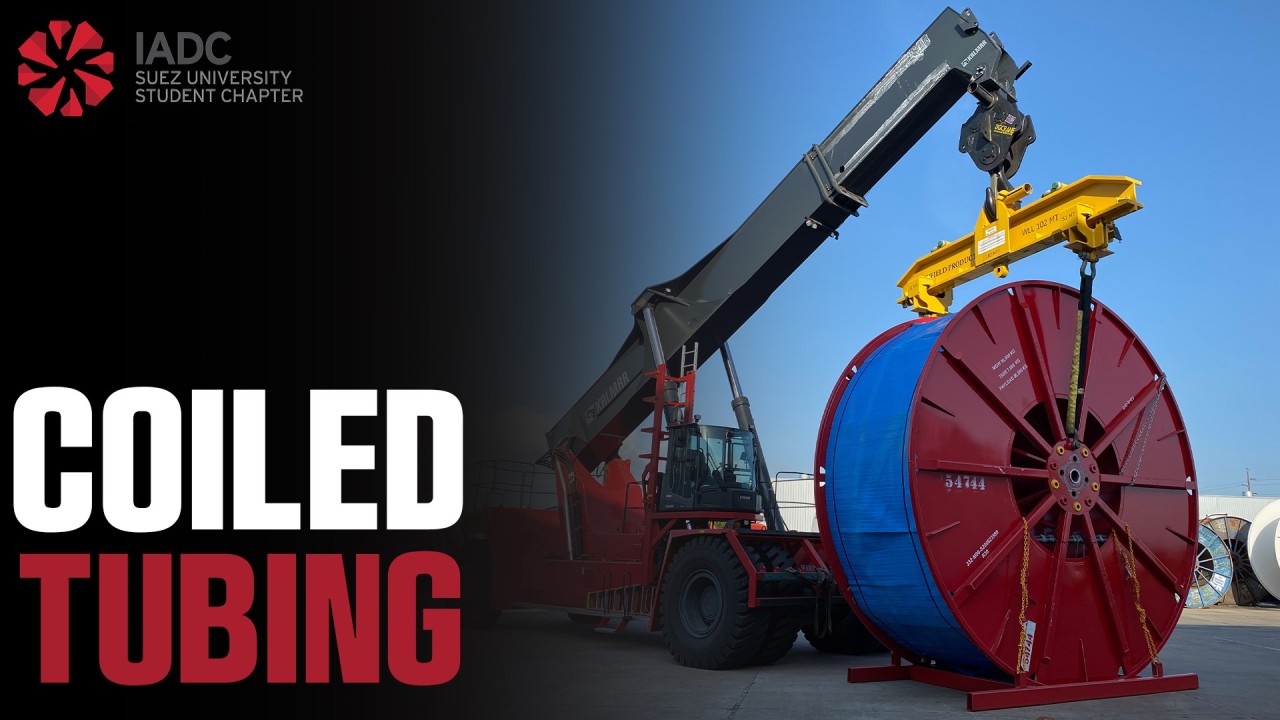
Coiled Tubing is usually defined as a continuous small diameter pipe string, which connects several surface equipment and associates drilling, repair, completion, and hole refurbishment work, and can be used in both terrestrial and marine environments. This pipe is usually constructed of a special carbon steel alloy, allowing it to be handled as PVC (Polyvinyl Chloride) pipes that possess characteristics of flexibility, antioxidation, fire resistance in some cases, among others.

The Surface Components of Coiled Tubing Equipment
The main components of a coiled tubing unit are.
1. Injector and Tubing Guide Arch Control Cabin
2. Service Reel with CT
3. Power Supply or Prime Mover
4. Control Console and Monitoring Equipment
5. Downhole CT Connectors and Bottom Hole Assembly (BHA) Components
6. Well-control Stack Equipment

1. Injector and Tubing Guide Arch:
The coiled tubing injector is a device that grasps and exerts the necessary force to deploy and retrieve the continuous tubing in and out of the wellbore.
2. Service Reel with CT:
The coiled tubing injector is a device that grasps and exerts the necessary force to deploy and retrieve the continuous tubing in and out of the wellbore. It is an essential component of the equipment used.
3. Power Supply or Prime Mover
Most prime mover packages in coiled tubing units are powered by diesel engines and multistage hydraulic pumps with pressure ratings ranging from 3,000 to 5,000 psig. This is the general configuration of prime mover packages used in such units.
4. Control Console and Monitoring Equipment
The console contains the necessary controls and gauges to operate and monitor the components of the coiled tubing unit, including the red and injector heads, and the control system for regulating the drive chain, stripper rubber, and blowout preventers.
5. Downhole CT Connectors and Bottom Hole Assembly (BHA) Components
In coiled tubing (CT) services, various connections isolate pressure and transfer tension, compression, and torsional loads from tools and bottom hole assemblies to the tube.
6. Well-control Stack Equipment
The well-control stack system plays a crucial role in the pressure containment package of a coiled tubing (CT) unit, consisting of a stripper assembly and hydraulically operated rams.
Downhole Equipment (BHA’s) of Coiled Tubing
1. Coiled Tubing Connector
A connector is used to connect BHA to the end of the coiled tubing.
There are a few types of coiled tubing connectors
such as external and internal.

2. Check Valve
The main function of the check valve is to prevent the backflow of liquids up the coil in case of pressure loss due to coil damage.

3. Jars
Jars are often used when coiled tubing gets stuck at the bit.When activated, jars provide an additional tensile force that can help with getting coil free.
4. Hydraulic Disconnect
The disconnect is used in case of emergency when the coil tubing is stuck downhole at the bit, and nothing can be done to get it free. When disconnect is activated, everything below it is left downhole.
The portion of the tool left in the well has to be retrieved later with a larger diameter string.
The disconnect is usually activated by pumping a special disconnect ball down the coil.
5. Release Joints
CT release joints are tools, which are used to easily separate the coiled tubing from the rest of the tool string. These tools allow easy connection and disconnection of the CT. The release joints are available such as; Pressure-activated release joint, Tension-activated Release Joint, and a combination of both types.

6. Vibrational Tool (Agitator/Extended Reach Tool) Figure 5 Release Joints
A vibrational tool is often used in extended-reach operations to decrease the friction coefficient between the coiled tubing and the casing and allow it to go deeper in the well.
Most vibrational tools work by momentarily stopping the flow of water which creates a water hammer effect. This pulse creates an axial force that allows coiled tubing to overcome friction and get deeper in the well.
Agitation tools are mainly used during the mill out operations because the debris created during milling add additional friction. With the wells becoming longer there is a demand for more aggressive agitation tools that can help coiled tubing to get deeper in the well without pumping a lot of metal to metal friction reducer.
It is also believed that agitation tools allow a better clean out of the wellbore by lifting debris from the bottom of the casing when the coiled tubing vibrates.
The Advantages of Using Coiled Tubing
Utilizing coiled tubing provides numerous benefits across different industries and applications. Here are some of the key advantages of coiled tubing:
1. Versatility
Coiled tubing is highly adaptable and can be utilized for various operations such as intervention, stimulation, cleanouts, logging, and production enhancement. Its flexible nature allows it to navigate complex wellbore configurations efficiently.
2. Cost-Effectiveness
Coiled tubing operations often require smaller crews and equipment since killing well is unnecessary, leading to cost reductions. It enables faster deployment, minimizing the need for time-consuming rigging-up processes and enhancing overall operational efficiency.
3. Time Savings
Coiled tubing operations are generally faster compared to traditional methods as there is no need for frequent trips in and out of the wellbore. This enables swift mobilization, increases productivity, and reduces downtime.
4. Enhanced Well Control
The continuous length of coiled tubing minimizes the risk of connection failures, ensuring better well control during operations. Real-time monitoring and control capabilities allow for immediate response to well conditions.
5. Environment and Safety:
• Decreased audio-visual impact.
• Low impact on the ground.
• Possibility of remote command, providing security to personnel.
• Decrease in the amount of waste.
Coiled Tubing Applications
1. Drilling Applications
During the drilling portion of the well coiled tubing can be used to evaluate the reservoir, pushing logging tools far beyond the reach of wireline tractors. It enables the operator to precisely choose the best place to perforate and frac, increasing productivity while saving time and money. Coiled tubing units are much quicker to deploy and there is no need to pull and re-run the completion tubing enabling the well to come on-line much quicker and expedite production.
2. Perforation:
The flexible pipe has achieved great success when performing re-entry drilling, in which a horizontal side is drilled into an existing well with a flexible pipe carrying an engine and a mud sweep. Re-entry drilling with flexible pipe can be performed through the existing production pipe and under low-balance conditions. Drilling new wells from the surface with larger 3-1/2" and 4-1/2" flexible pipe has been successful in certain markets, especially in shallow gas wells in Canada
3. Profile (Registers logging) / Perforation:
Cables installed within the flexible pipe allow the deployment of profiling or drilling tools in highly deviated wells. Flexible piping offers several advantages over traditional cable methods, including increased tensile strength resistance and compression, as well as the ability to work in live wells
4. Fracture
It has advantages over traditional methods when fracturing relatively shallow wells with multiple termination zones. Flexible pipe can transport zonal insulation tools to locate the fracture Petroleum Engineers Association treatment and then the flexible pipe is used as a conduit for the fracturing fluid. The fracturing process can be repeated several times in a single run
5. Milling/Grinding of Fracture Plugs
Large multi-stage fracture treatments common in horizontal shale gas terminations require the installation of multiple fracture plugs for zonal insulation. Flexible pipe, along with bottom motor and bore or mill, is used to mill or grind fracture plugs and clean the well.
6. Cleaning
Flexible pipes can be used to remove inlays, produced sand, fracture sand, and well debris. The flexible pipe runs into the well, fluid is pumped through the coiled tubing and the returns are circulated through the annular space. The flexible pipe can reach the depth quickly without having to kill the well or remove the production pipe.
7. Stimulation
Flexible pipe matrix stimulation treatments are designed to restore the natural permeability of the formation near the well by injecting treatment fluids into the well. Flexible pipe stimulation can be performed in live wells and combined with other operations, such as nitrogen injection.
8. Speed String
Flexible pipe is fed into an existing production well to reduce the effective flow area, allowing the natural pressure of the reservoir to lift water from the reservoir, allowing natural pressure to maintain production in mature producing wells.
9. Installation of Submersible Electric Pump (ESP)
An ESP cable can be installed in the flexible pipe prior to deployment, allowing the flexible pipe to support the ESP cable and facilitate the rapid installation and recovery of ESPs.
10. Displacement with N2
In circulation movements, nitrogen is pumped through tubing and/or coiled tubing, and fluids are circulated from the well to the surface. Then the nitrogen can be purged and well evaluated, punctured, or put into production. It is usually necessary to pump nitrogen through the ring and into the tubing and/or coiled tubing. In injection displacements, the fluid is forced into the formation instead of being

circulated outside the ring. This technique is used to displace stimulation fluids or chemicals within the formation.
The Disadvantages of Coiled Tubing:
• One disadvantage of CT is its inability to rotate. This means you cannot turn the pipe, which limits its flexibility and capability in certain operations.
• Another disadvantage is the risk of fatigue and wear on the tubing due to repeated bending and straightening during use. Over time, this can weaken the tubing and increase the likelihood of failure, leading to potential safety hazards and increased maintenance costs.