

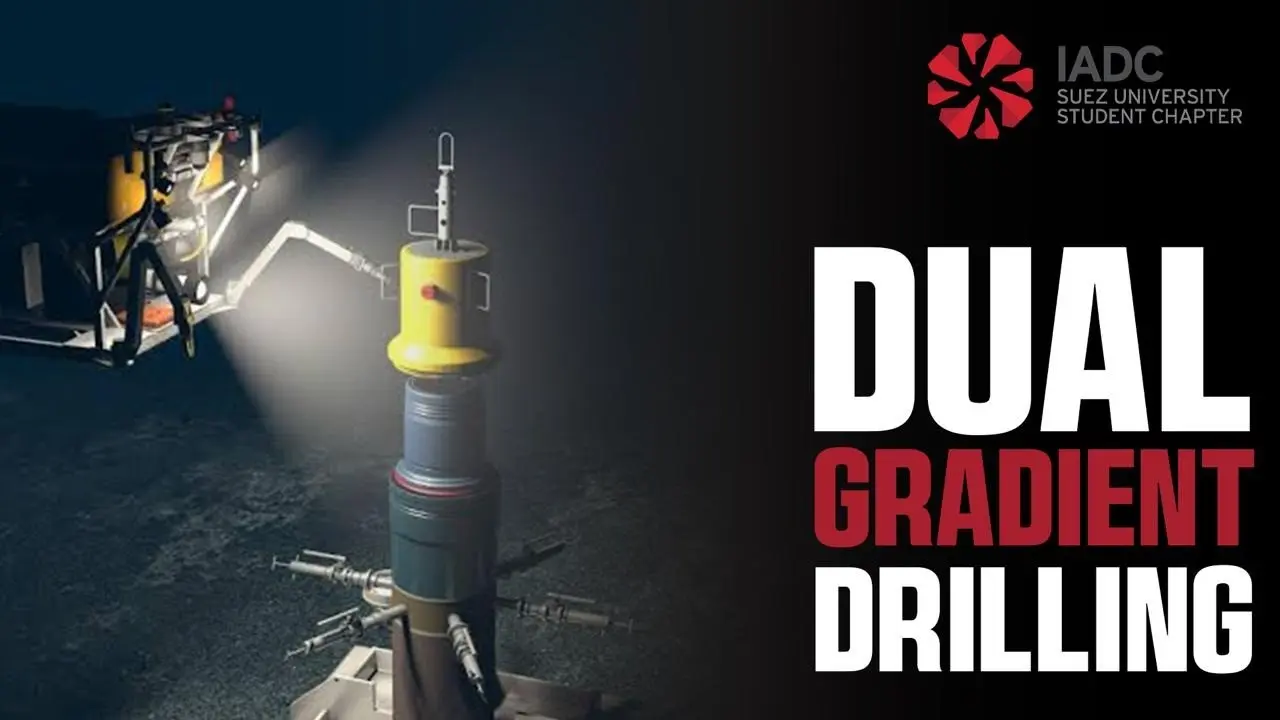
Dual gradient drilling emerged as one possible answer to a challenge present in deep water environments. In certain formations, additional casing strings may be required to maintain well bore pressure balance and bore hole stability.
Unfortunately, this can prevent the well from reaching target depth with sufficient borehole size to make the well economically feasible. To address this challenge, the idea of dual gradient drilling was introduced as a way to remove the hydrostatic pressure of the drilling fluid column between the ocean floor and the drilling rig from the wellbore pressure.
A subsea pumping system is used to return the drilling fluid from the well to the rig. In some cases, the subsea pump could also separate out the drill cuttings and deposit them into a separate dummy well; otherwise, the pump would carry the cuttings and drilling fluid back up to the rig.

Under conventional single-gradient drilling (hereinafter referred to as SGD), the bottom hole pressure is made up of two components i.e. hydrostatic pressure and pressure friction loss during the drilling mud annular flow movement from the bottom-hole to the wellhead. For better understanding, we will not consider herein the influence of cuttings/ROP on the hydrostatic component of pressure, as well as RPM of top drive, eccentricity of bottom-hole equipment (BHA), and flow properties upon pressure friction loss within the annular space. Under static conditions of the well the last component of the equation is zeroed and the bottom-hole pressure is reduced (Fig.2).

Drilling technology that uses or simulates the effect of two fluids of different gradients in the annulus to create dual hydrostatic gradients to better manage the annular pressure profile. NOTE: This technology is used to facilitate well construction through enhanced wellbore pressure management. Due to the application of a set of additional equipment MPD there appear conditions of a closed circulation circuit (similar to circulation conditions with a closed blowout preventer (BOP) enabling to add an additional component to the equation i.e. surface backpressure (SBP) (Fig. 3).

The backpressure is especially important in static conditions thereby enabling compensating for the absence of friction pressure loss in the annular space keeping the bottom-hole pressure unchanged. Such notions as equivalent circulating density (ECD) and equivalent static density (ESD) are used for better comparison of both hydrostatic head and flowing pressure in the well with mud density and the formation pressure gradients and fracture pressure (FP). ECD of the drilling mud is the equivalent of the flowing pressure in the well expressed as density (most often in g/cm3). In the absence of drilling mud circulation the notion of ESD is used i.e. the value of the mud density equivalent to the bottom-hole pressure in static conditions being more relevant in wells where MPD technology is applied.
Unlike conventional SGD or MPD the DGD is applying two hydrostatic pressure gradients. For example, the seawater gradient (the top mud in Table 1) from the sea surface to the seabed is used to control the well, while the mud gradient from the seabed to the bottom-hole is used for the wellbore stability and removing cuttings therefrom (Fig. 4).

The drilling rig may be conventionally said to be located on the seabed, since the overlap of the water column is balanced by the seawater line gradient (Fig. 5 b). The DGD is to be noted to be already applied in drilling of pilot holes or upper sections of wells prior to BOP installation.

(a) – red solid line, (b) – blue solid line till “Seabed” line further being changed to brown solid line
The two fluids within the annulus may present more favorable wellbore pressure profile compared to conventional drilling. The DGD system is transforming the general pressure profile with depth compared to conventional drilling providing a larger drilling margin by shifting the pressure profile to the left.

RISER FEATURES
Although some companies are proposing dual gradient systems that utilize concentric risers (one inside the other), the majority of systems utilize a conventional riser with a separate fluid return line. Stewart & Stevenson’s DMRS™ (Drilling Mud Return marine riser System) smoothly integrates a 7-in. fluid return line into the riser, along with choke and kill lines, booster line and hydraulic line. Combining these components into the riser cuts down on the number of separate strings the rig has to manage.

This is important because using multiple strings makes it more difficult to weathervane the drill ship into the wind, since a ship can more easily rotate around a single point in the moon pool.
Use of a fluid return line will not only be used in dual gradient drilling, it also offers advantages in conventional drilling.
REDUCED MUD
Of course, there is an obvious consequence in using a 7-in. diameter drilling fluid line as opposed to a typical 19-in. internal diameter riser—the amount of drilling fluid is reduced by two-thirds. The Stewart & Stevenson patented dual gradient coupling is in service on deep water drilling rigs. May/June 2001 This makes the riser more environmentally friendly since the smaller volume of fluid reduces the negative environmental impact in the event of an emergency disconnect. Other benefits derived from the reduction of drilling fluid could include:
- Reducing the required drilling fluid storage capacity on the rig;
- Reducing the time required to change fluid weights;
- Reducing the time required to circulate the drilling fluid in or out of the well;
- Reducing the dilution of the down hole drilling mud with mud from the booster line;
- Reducing the tensioner requirements of the riser;
- Reducing the amount of tensioning capacity required on the rig;
- Reducing the wear and maintenance on the tensioner.
Dual Gradient Pressure Drilling Technology at CAPM
"Continuous Annular Pressure Management (CAPM)" System is considered to be one of the most promising and under analyzed methods of the DGD.
The principle of CAPM system operation is shown in Figure 6: low density drilling fluid (light-weight drilling mud) is pumped into the annular space through the kill lines, where over the lower riser package it is mixed with the heavy-weight drilling mud flowing up from the bottom-hole to the surface. A diluted mud is thereby made inside the riser. The diluted mud on the surface (either platform or ship) is passing through the treatment system to the centrifuge being separated again to light- and heavy-weight drilling mud. As a result, the bottom-hole pressure is formed as the sum of the hydrostatic pressure of the heavy drilling mud column and the diluted mud.

The CAPM (Controlled Annular Pressure Management) system consists of key components designed to manage drilling mud circulation and pressure control during drilling operations.
- Rotating Control Device (RCD) and Bearing Packing Unit (BPU): These are installed at the telescoping joint between the riser and tensioner to prevent drilling mud from exiting the well and to direct it through a closed loop, enabling BHA rotation and drilling activities.
- API CAPM Choke Manifold: This assembly of valves and chokes manages the flow of diluted mud from the well and regulates annular pressure.
- Programmable Logic Controller (PLC): The PLC collects and processes data from DGD instrumentation and mud logging, facilitating remote automatic control of integrated mud cleaner hydraulics. It serves as the interface between the human-machine interface (HMI) and DGD equipment.
- Human Machine Interface (HMI): This software allows operators to control DGD equipment by sending commands to the PLC. It includes a well analysis model for automatic pressure control, adjusts backpressure based on real-time drilling data, and has early detection capabilities for fluid kicks or losses.
- Coriolis Flowmeter: This device measures drilling mud flow using the Coriolis effect, providing accurate flow data to monitor for losses or manifestations by comparing inlet and outlet flows. Backpressure Pump: This pump maintains mud flow in the DGD system, controls annular pressure during operations, and can be activated remotely. A coarse filter is used to protect it from impurities in the drilling fluid.
- CAPM Centrifuge: A decanter centrifuge capable of separating diluted mud into light- and heavy-weight components, with a capacity of 11,000 l/min across six units required for continuous operation.
- Flow Stop Downhole Valve: Installed above the bit, this valve halts mud flow from both the annular space to the drill string and vice versa when circulation stops. Its opening pressure is adjustable based on water depth and mud density.
Overall, these elements work together to ensure efficient drilling operations, effective pressure management, and real-time monitoring of well conditions.
DUAL GRADIENT ADVANTAGES
The dual gradient approach offers several advantages over conventional drilling in very deep water. Because pore, fracture and mud pressure gradients are referenced to the mudline instead of the rig, dual gradient drilling increases the margin between pore pressure and fracture gradient. That, in turn, offers key benefits:
- It is possible to reduce the number of casing strings;
- A larger completion string provides increased flow capacity;
- Riser margin is in place at all times, so disconnect well control hazards are reduced;
- Drilling efficiency and mechanical risk are improved, lowering well costs.
Dual gradient drilling, once it is perfected, will enable companies to drill deeper in challenging field formations at reduced cost and risk, making these projects more profitable. Although normal deep water drilling techniques will continue to dominate for years to come, dual gradient drilling gives the industry a valuable tool to overcome obstacles to even greater production that was previously unattainable.
The DGD opens up new fields for technological possibilities in making deep-water wells with "narrow mud window". Reducing the cost of well construction by up to 40% due to the application of this technology may result in increase of financing for geological exploration.