

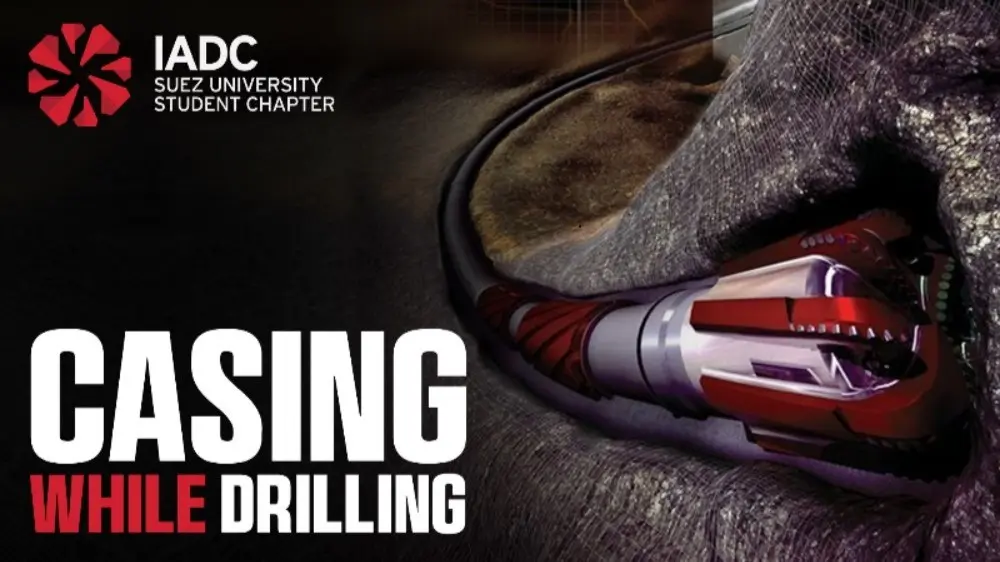
CWD is one of the alternatives of controlled pressure drilling like Constant Bottom hole Pressure, Pressurized Mud Cap Drilling, or Dual Gradient Drilling Casing while drilling is an alternative to conventional drilling using the casing as drilling string, drilling, and casing the well simultaneously.

The concept of drilling and casing the hole at the same time is, of course, valuable by combining two time-consuming processes. So the main purpose of Casing While Drilling (CwD) is to eliminate classic casing runs and isolate formations while drilling. Using Standard casing string instead of the conventional drill string, the drilling and casing are executed simultaneously, section by section. Casing While Drilling is also a hazard mitigation solution, applicable in drilling soft shallow sections with high borehole instability and known losses.
How is it performed ?
The introduction of the casing running tool (CRT) has made way for Casing Drilling. When the casing is run with top drive and CRT, you are able to operate the casing string much in the same manner as a drill string. The top drive casing running tool (TDCRT) lets you push, pull, rotate, and reciprocate, thus giving you extended control over the string.
On level two, CwD is used in drilling vertical wells with non-retrievable bits, mostly for surface and soft sections. On level three, CwD is used for drilling directional with casing, with retrievable BHA’s, mostly for deeper and challenging sections.

𝐓𝐡𝐞𝐫𝐞 𝐚𝐫𝐞 𝐛𝐚𝐬𝐢𝐜𝐚𝐥𝐥𝐲 𝐭𝐰𝐨 𝐦𝐞𝐭𝐡𝐨𝐝𝐬 𝐟𝐨𝐫 𝐜𝐚𝐬𝐢𝐧𝐠 𝐰𝐡𝐢𝐥𝐞 𝐝𝐫𝐢𝐥𝐥𝐢𝐧𝐠:
1. Rotate the casing from the surface to send the torque to a bottom hole assembly that drills and cements.
2. Run in a retractable bottom hole assembly, run inside the casing, incorporating a bit and a reamer.

Types of Casing while Drilling Systems
Three main types of CwD, which are determined by the configuration and operation of the drill, are as follows;
1. Non-Retrievable Casing While Drilling System
2. Retrievable BHA Casing While Drilling System
3. Drilling with Liner Systems
Non-Retrievable Casing While Drilling System
The non-retrievable system is the simplest type of CwD. In this case, the system is made up of a drillable bit or drill shoe, a casing string, and a casing drive system. The drill shoe is fitted securely to the bottom of the casing string; the latter is rotated by a power swivel which is hooked up to the drive system. This system only offers a limited number of options- it can only drill in a straight hole, and to a pre-determined depth.

Retrievable BHA Casing While Drilling System
The retrievable casing while drilling BHA system strikes a balance between conventional drilling tools and CwD. The main advantage of this system is that it can be steered, and used with both conventional measured while drilling (MWD) and logging while drilling (LWD) tools.

Drilling with Liner Systems
Drilling with Liner (DwL) works in much the same way as the previous two systems, except it does not involve the use of a casing drive system. The liner hanger setting tool is connected to the drill pipe, and then attaches to the power swivel at surface. There are three sub-types of this system: non-retrievable, wireline retrievable and drill pipe retrievable.

What are the benefits?
1- Maximizing efficiency
2- Two operations in one, each meter drilled will be cased.
3- Reduces time for tripping in and out, and the risk involved with it.
4- Improves drilling efficiency by reducing the non-productive time.
5- Drilling time and cementing savings.

6- The smearing effect: Prevent and cure (or minimize) losses while drilling, i.e. good control of the annular pressure losses.
7- Applicability in depleted zones or underbalanced drilling applications.
8- High applicability in drilling soft shallow sections (high borehole instability with known losses).
9- Provide low kick volume.

What will decide if CWD is suitable for a specific project?
Geology:
With level 2 CWD (using drillable bits) most surface sections are suitable for casing drilling. These sections are characterized by various layers of clay (or marl), sand, conglomerates, gravels, sandstones, and coals. However, a detailed analysis is required in order to select the most suitable casing drilling bit (PDC type) for your section.
Rig type
1- The rig has to be equipped with a top drive.
2- An efficient pump system and mud system is required.
In the context of ever rising costs of well drilling, many of them performed in new geological structures, deep wells, implying a series of geological and technical risks, more and more companies are experimenting and implementing new drilling techniques and technologies with the aim of reducing non-productive times, technical accidents while drilling, and risk mitigation.
Casing while drilling, constantly improving over time, has proven an efficient method to reduce risks, especially those related to the presence of a conventional drill string in the borehole, maintenance of borehole stability or loss of circulation. Moreover, by reducing non-productive times and additional costs to overcome difficulties and technical accidents while drilling, implementation of casing while drilling results in significant cost savings.